01 · Question
One falsifiable projection question
In a qualified XMM EPIC observation that crosses the M101 D25 elliptical boundary, after controlling for point sources and declared nuisances, does the diffuse X-ray surface brightness outside the boundary still show a positive residual above a material threshold?
"Crossing" here does not mean drawing a circle on the sky. The primary quantity β_D25 must be defined in the same response domain, with a pre-frozen elliptical natural radius ρ, first-order sin(PA)/cos(PA) azimuthal terms, a source-plus-background likelihood, and a same-unit material threshold δ_D25. None of these qualification conditions are yet complete.
02 · Why it matters
Existing work sees complex central diffuse emission; it has not answered whether D25 is a usable transition coordinate
An XMM-Newton view of M101 — III. Diffuse X-ray emission (Warwick, Jenkins, Read, Roberts & Owen 2007) saw both a smooth radial component and spiral-arm structure in source-excluded residuals within the central 10′. The Chandra M101 Megasecond: Diffuse Emission (Kuntz & Snowden 2010) further showed that X-ray surface brightness couples strongly to FUV, radius, and local structure. Magnetic fields and hot gas in M 101 (Weżgowiec et al. 2022) found that the two-thermal disk/halo decomposition in non-arm regions is sensitivity-limited.
Together these results mean: the optical D25 cannot be taken for granted as a gas boundary, and a model with only geometric radius must not misread spiral, absorption, or background structure as a boundary jump. The value of I226 is to turn this premise into a narrow, explicit test: if D25 retains a material-level residual after the full azimuthally robust model, it becomes a candidate coordinate for disk–outer-atmosphere studies in face-on spirals; if not, the empirical basis for that coordinate is weakened.
This is not "validating a halo model." A single projection measurement in one galaxy can only update the evidence for M101 at this angular scale, with this model and this sensitivity.
03 · Sky geometry
Archival coverage reaches the centre; no verified minor-axis outer offset field exists
M101's RC3 D25 is 28.84′ × 26.91′, PA=21°. The aimpoints of all seven public Full-Frame EPIC observations lie within 6.163′ of the target centre; the closest, 0824450501, is still a near-centre proxy at PA≈66° and cannot substitute for minor-axis response/mask/GTI conditions. The figure below uses an illustrative 15′, PA=291° (NW) pointing centre: it shows nominal sky geometry only and does not freeze I226's pointing, cell, mask, buffer, or detector footprint.
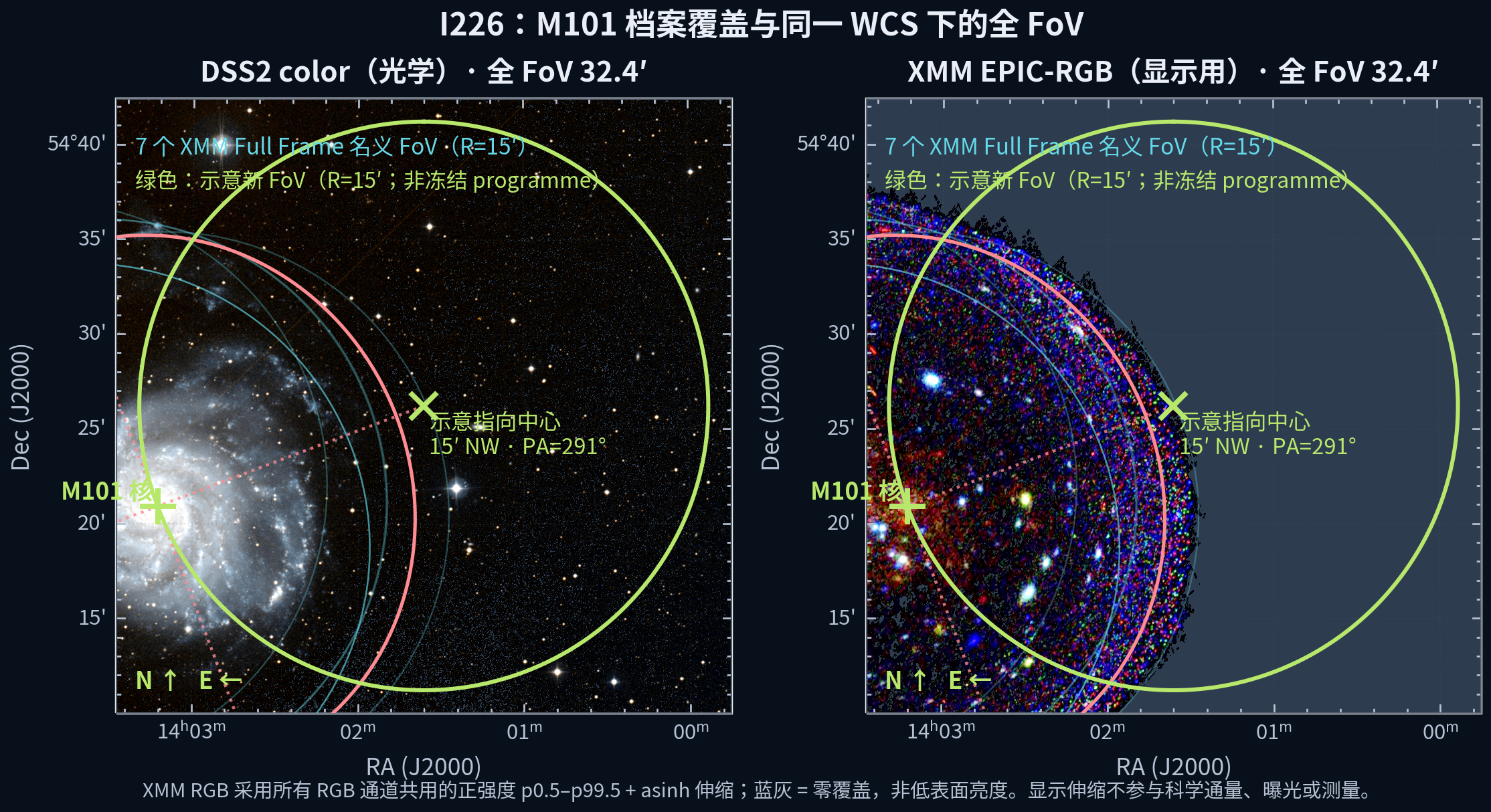
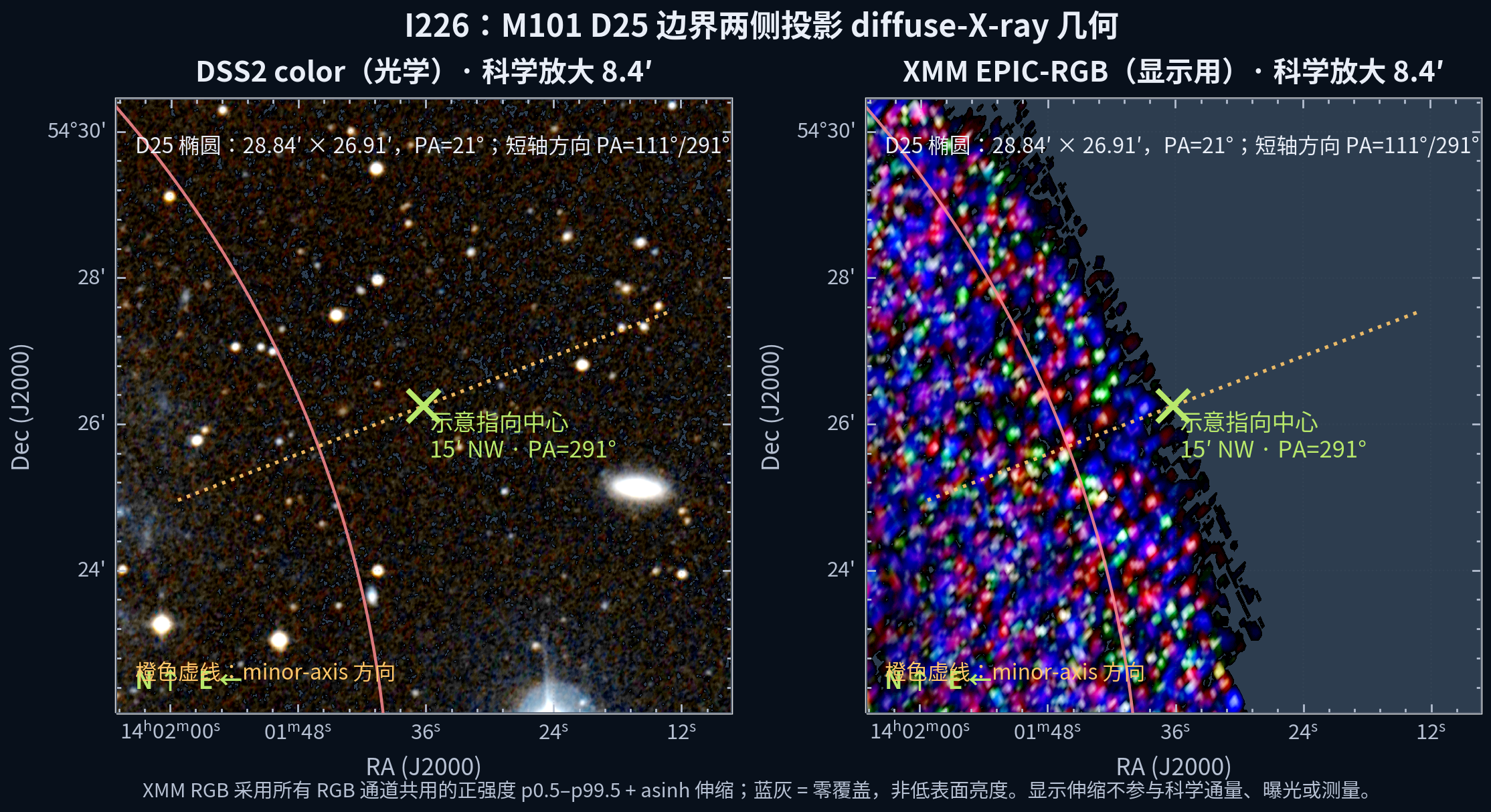
XMM RGB uses a common positive-intensity p0.5–p99.5 percentile clip and asinh stretch across all channels; blue-grey indicates zero coverage, not low surface brightness. This display stretch does not enter exposure correction, scientific flux, or β_D25 measurement; overlay lines use the original WCS.
04 · What is actually measured, and why the parent value cannot be reused
Measuring a boundary coefficient, not "is there a halo?"
After qualification, the pre-frozen primary model is:
Σ_X,i = α + b₁(ρ_i−1) + b₂(ρ_i−1)²
      + a_s sin(θ_i) + a_c cos(θ_i)
      + β_D25 O_i + Z_iγ + ε_i
O_i is the outside-D25 indicator; ρ=1 lies on the D25 ellipse; θ is the sky position angle relative to the M101 nucleus. A frozen finite interval [L_D25, U_D25] is required: only if all qualification conditions pass and L_D25 > δ_D25 is the result SUPPORT; only if U_D25 ≤ δ_D25 is it WEAKEN; anything else is INCONCLUSIVE.
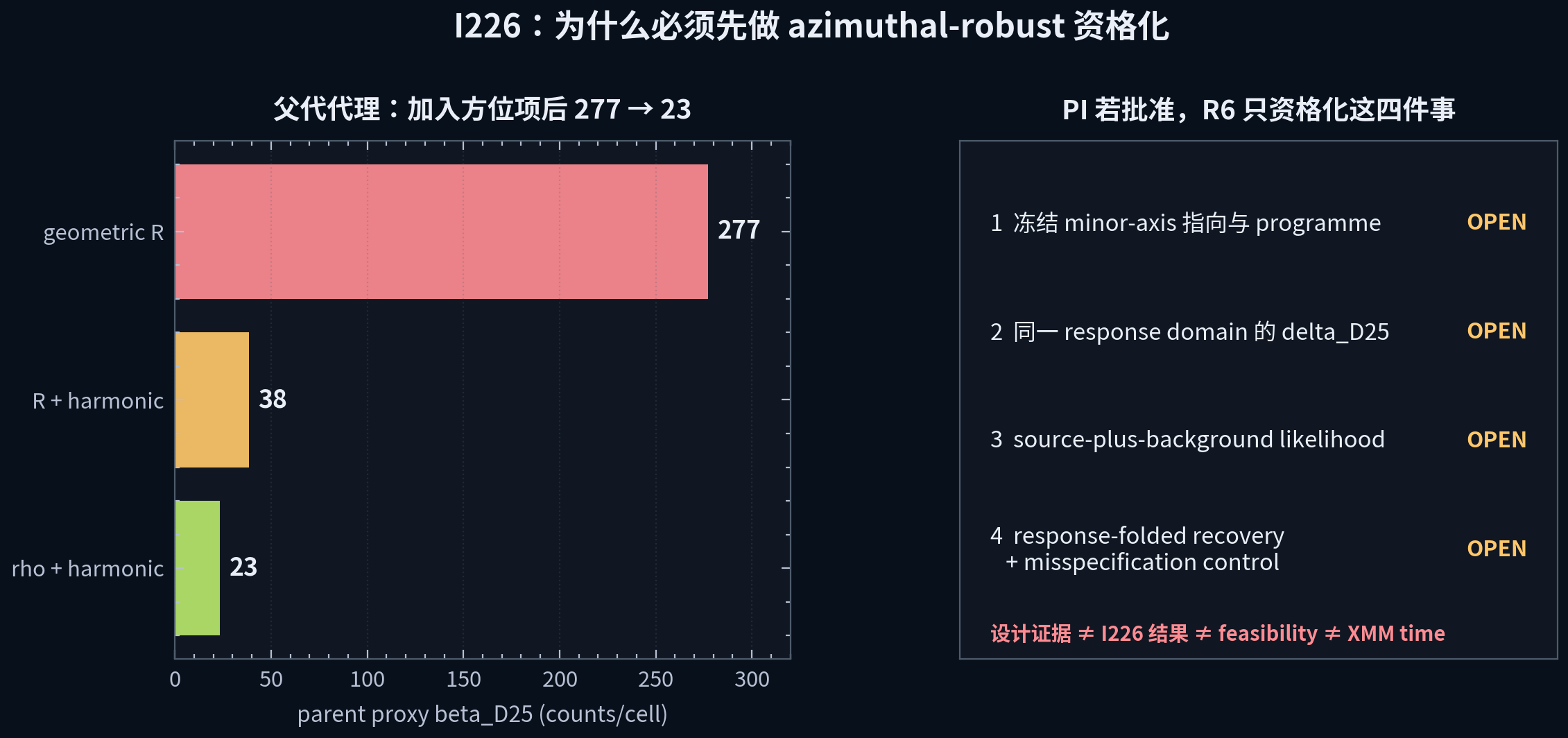
β_D25 dropped from 277 counts/cell in the geometric-R model to 23 counts/cell in the full ρ+sin(PA)+cos(PA) model; this is not an I226 result and not a feasibility proof, but design evidence that azimuthal structure must be included in the model first. Download 1-column PNG · Download 2-column PNG05 · If the answer is opposite, or unanswerable
An honest WEAKEN is informative; an unqualified null is not
- SUPPORT: A material-level positive boundary residual survives in the frozen response domain. It supports only the boundary residual under this projection model.
- WEAKEN: At a sensitivity that has met recovery/coverage standards, the interval upper bound still does not exceed the material threshold. It weakens the claim that "D25 is a usable diffuse X-ray transition coordinate"; it is not equivalent to "there is no halo."
- INCONCLUSIVE: If any of the same-unit threshold, real detector/mask/GTI support, background likelihood, or response-folded recovery fails, no physical conclusion is drawn. Such a null is boring and not worth dressing up with pretty graphics.
06 · Cost and what is still unknown
The only request on this page: authorise one qualification HEAVY first; do not approve observing time
The next step R5 left for I226 is heavy_pending: an R6 work package must freeze a concrete minor-axis pointing/program, a same-unit δ_D25 for the camera/band/cell area, a source-plus-background likelihood, and perform response-folded injection/recovery plus radial-variation harmonic misspecification control in the full ρ+sin(PA)+cos(PA) model.
"About 140 ks" is only an unqualified historical design envelope, not an exposure request on this page and not a sensitivity calculation. Actual clean time, outer-D25 source brightness, detector gaps, vignetting, post-mask area, background, and recoverable material threshold are all unknown. If this HEAVY qualification fails, the correct action is to stop at INCONCLUSIVE, not to package unknown costs as a proposal.
Actionable choice for the PI
Approve: Approve only the R6 HEAVY qualification package described above; it does not automatically approve an XMM time request.
Do not approve: Stop here. This page has stated that there is currently insufficient evidence to commit observing time or claim a halo/CGM result.
Sources and reproducibility
Evidence boundary of this page
- Warwick, Jenkins, Read, Roberts & Owen (2007), An XMM-Newton view of M101 — III. Diffuse X-ray emission, MNRAS 376, 1611–1620. arXiv
- Kuntz & Snowden (2010), The Chandra M101 Megasecond: Diffuse Emission, ApJS 188, 46. DOI
- Weżgowiec et al. (2022), Magnetic fields and hot gas in M 101, A&A 664, A108. arXiv
- Local traceable inputs: I226 idea card, R3 evidence, R4 critique/rebuttal, R5 adjudication, M101 source card, plus the frozen HiPS2FITS display inputs and parent D051 anchor for this page. All hashes, commands, and replay paths are recorded in the release manifest.
Release correction: This version corrects the v1 display-only artifact defect: the old figure's actual WCS centre was inconsistent with its caption, and the old decision PNG did not show the captioned 277→23 and R6 checklist. v1 is retained only as a rejected precursor; this correction does not change I226's science, Gate, or HEAVY status.